
What is Wise Freedom?
“Freedom is not the absence of structure, but rather a clear structure that enables people to work within established boundaries in an autonomous and creative way.” — Erich Fromm
Wise Freedom is a schoolwide ethos that balances student agency with developmentally appropriate accountability. It rejects the false binary that educators are so often forced into — either tighten the rules, or loosen the reins and hope for the best.
It offers a third way, creating school environments where students are trusted with real choices in proportion to their readiness, while adults stay close enough to help them reflect, repair, and grow.
Wise Freedom is a framework for middle schools that recognizes a simple truth: young adolescents do not become responsible by being controlled, and they do not flourish without boundaries. They grow when freedom is earned, scaffolded, and coached.

Why Middle School?
Middle school is the most under-theorized – and most consequential – stage of schooling. Early adolescence is a period defined by rapid neurological change, heightened sensitivity to environment, a widening gap between impulse and intention. Students at this age are neither children nor adults. They are works in progress, capable of remarkable insight one moment, and baffling decisions the next.
Wise Freedom begins here because this is where habits of decision-making are formed, and not yet calcified. Middle schoolers don’t need fewer choices. They need better designed ones.

Wise Freedom Framework
Wise Freedom is a framework for middle schools that recognizes a simple truth: young adolescents do not become responsible by being controlled–and they do not flourish without boundaries. They grow when freedom is earned, scaffolded, and coached.
What Do Middle Schoolers Need?
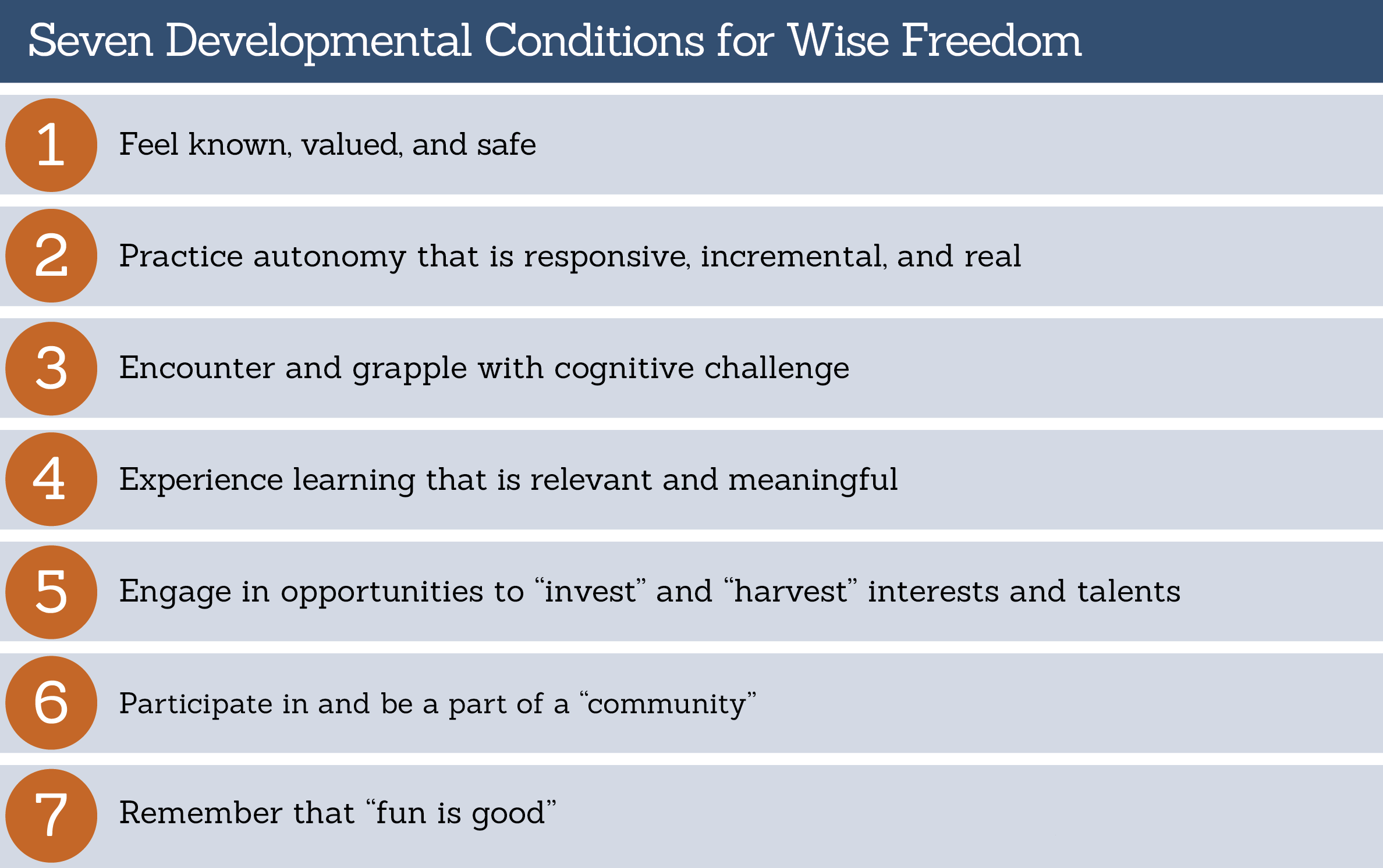
Over the past several decades, advances in developmental psychology, neuroscience, and educational research have transformed our understanding of adolescence. We know more than ever about how young adolescents think, learn, develop, and make decisions. Yet many middle schools remain organized around schedules, subjects, policies, and logistics rather than the developmental needs of the students they serve.
Wise Freedom begins with a simple premise: if we want students to become thoughtful, responsible, and increasingly independent, then our schools must reflect what we know about early adolescence. The seven needs here are not another initiative or checklist. They are the developmental conditions upon which Wise Freedom is built.
Bridging the Gap Between What We Know & What We Do
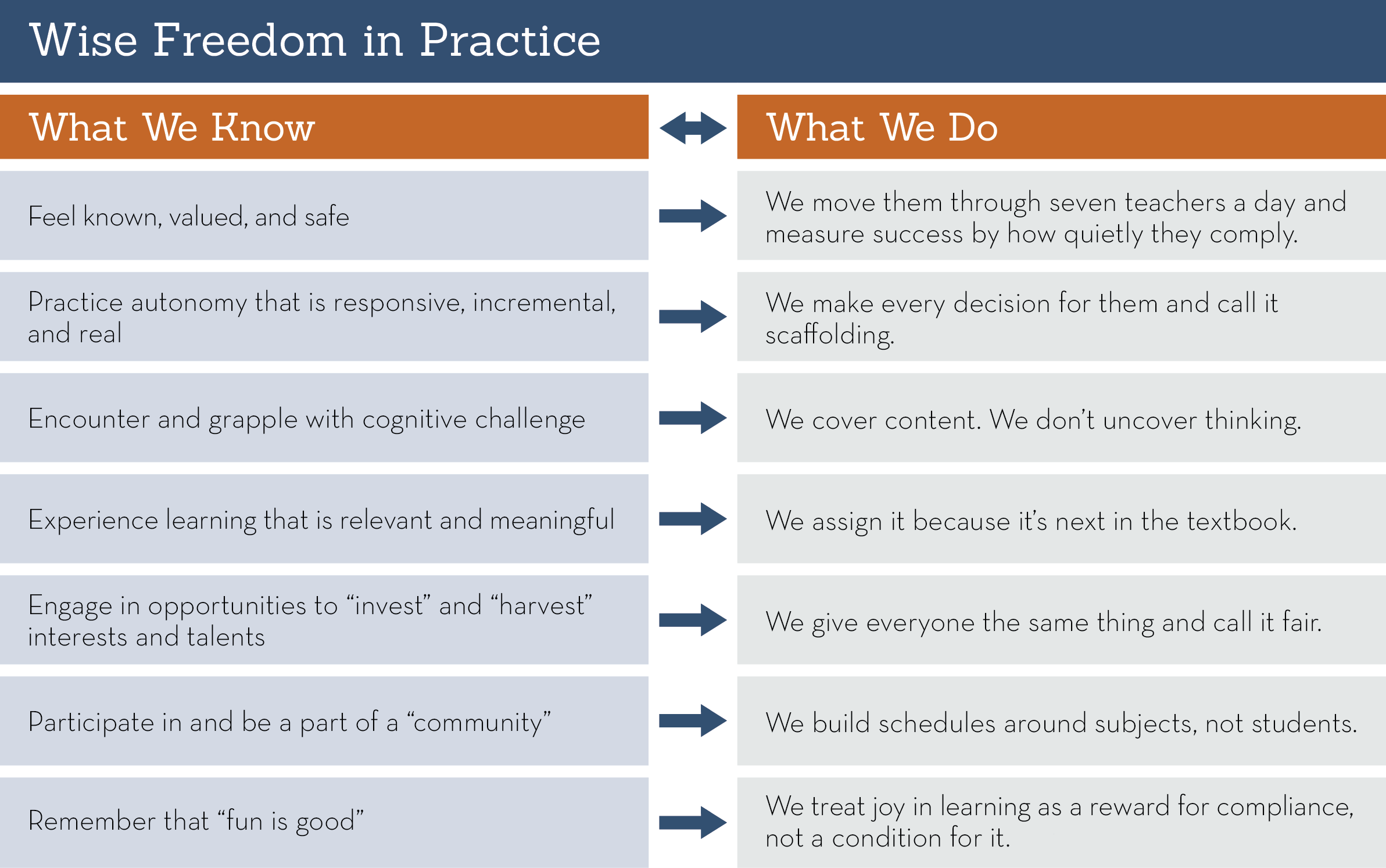
If understanding adolescence were enough, every middle school would already be a place where students thrive. But knowing what students need and designing schools around those needs are two very different things. Too often, our beliefs about young adolescents are at odds with the systems we create.
Wise Freedom is about bringing our practices into alignment with our principles. It asks educators to examine every policy, routine, and expectation through a simple question: Does this help students become increasingly capable of governing themselves? The comparisons here illustrate some of the most common gaps between what we know about adolescence and what many middle schools continue to do.
Wise Freedom Is a Whole-School Philosophy
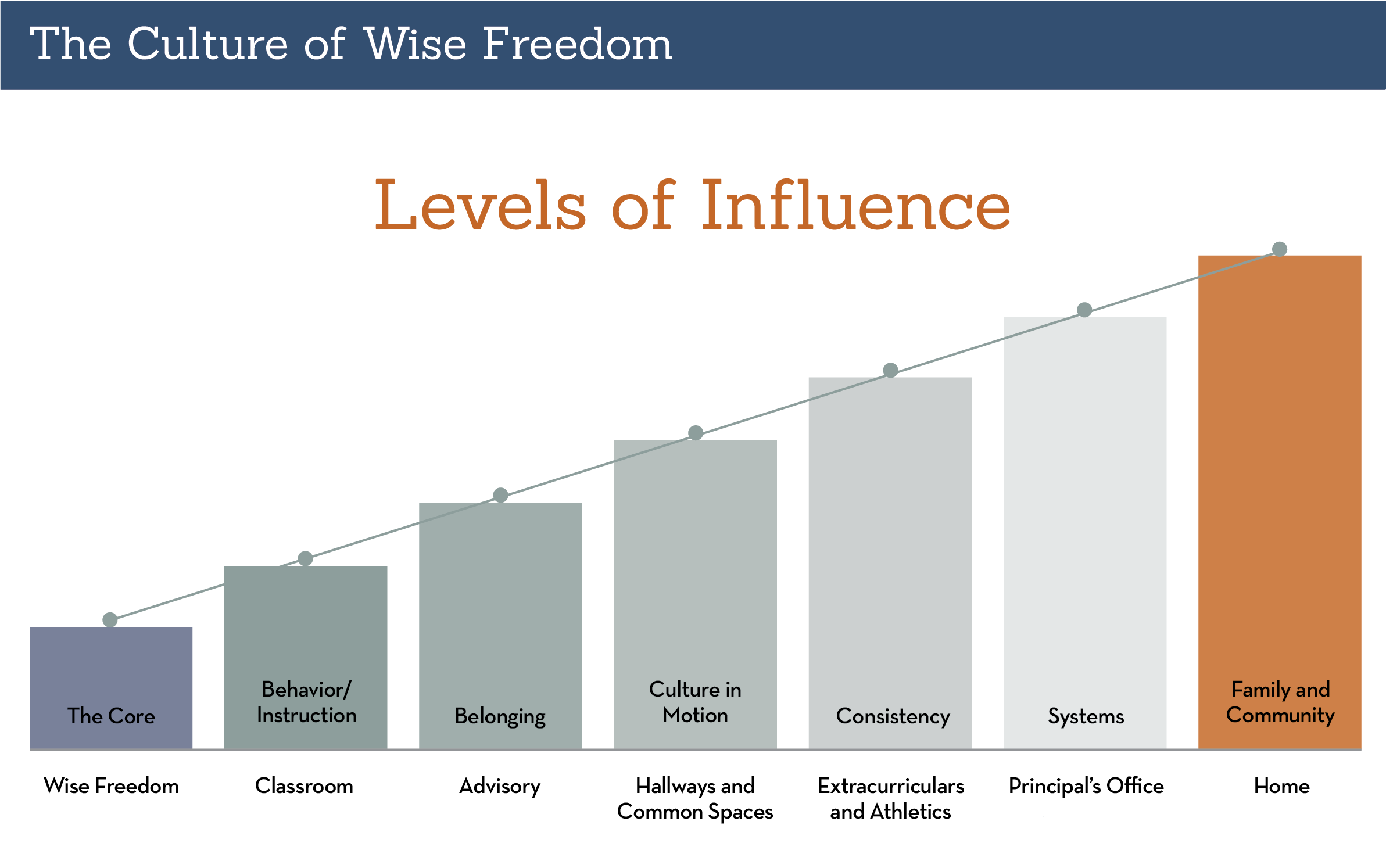
Students don’t experience school one classroom at a time. They experience it as a single, interconnected ecosystem. That’s why Wise Freedom isn’t, at its best and most effective, a curriculum, a behavior program, or a classroom management strategy. It’s both a practice and a philosophy that must inform every aspect of school life—from instruction and advisory to extracurricular activities, administrative decisions, and partnerships with families.
Middle schoolers are shaped by the continuous interaction of the environments they inhabit, each one influencing and reinforcing the others. When these experiences are aligned around a common set of values, students receive a coherent message. The framework below illustrates how a culture of Wise Freedom extends throughout a school. It may begin in the classroom, but it cannot end there.
Stay Connected
Wise Freedom is not a program to be adopted wholesale or a checklist to be followed. If it were merely a matter of belief, it wouldn’t be very hard to embrace. In some form or fashion, most of us already agree with its core tenets: that students need autonomy, that accountability matters, and that growth requires room to make mistakes.
The challenge isn’t in agreeing with the idea – it’s about putting this idea into practice. It’s easy to say the right things, but much harder to redesign the systems that shape daily life in a school, and that’s where Wise Freedom lives – in the practices, policies, routines, and systems that shape our students’ day-to-day experience.
Because these practices are shaped by history, constraints, and community, Wise Freedom cannot be implemented wholesale or replicated from one school to another. It must be worked out on the ground, one school at a time, shaped to fit the vessel it inhabits. Supporting that kind of work means that each school requires its own approach.
I support schools in this process by meeting them where they are and tailoring the work to their needs and readiness; I also contribute to the broader educational conversation through writing, conference presentations, and podcast conversations.
If Wise Freedom resonates with you, reach out.